30% off for life when you start your trial. Don’t just watch AI happen – lead it. Claim your discount >

Meta’s frequent ad policy updates can disrupt campaigns, causing ad disapprovals, account restrictions, and performance drops. Key challenges include vague rejection reasons, delayed reviews, and stricter rules for sensitive industries like health or housing. Here's how to manage these changes effectively:
Ad Disapprovals: Avoid personal attribute mentions (e.g., “Do you suffer from...?”) and ensure landing pages align with ad promises. Use Meta’s Account Quality dashboard to identify and resolve issues.
Performance Drops: Policy updates can reset learning phases, increasing costs. Consolidate audiences, limit edits, and focus on engagement metrics to stabilize campaigns.
Communication: Assign a policy owner to monitor updates, maintain a compliance log, and hold regular team syncs. Simplify updates for clients with clear summaries and visual aids.
Automation: Tools like AdAmigo.aipre-screen ads, flag violations, and adjust campaigns to meet policy standards, saving time and reducing errors.
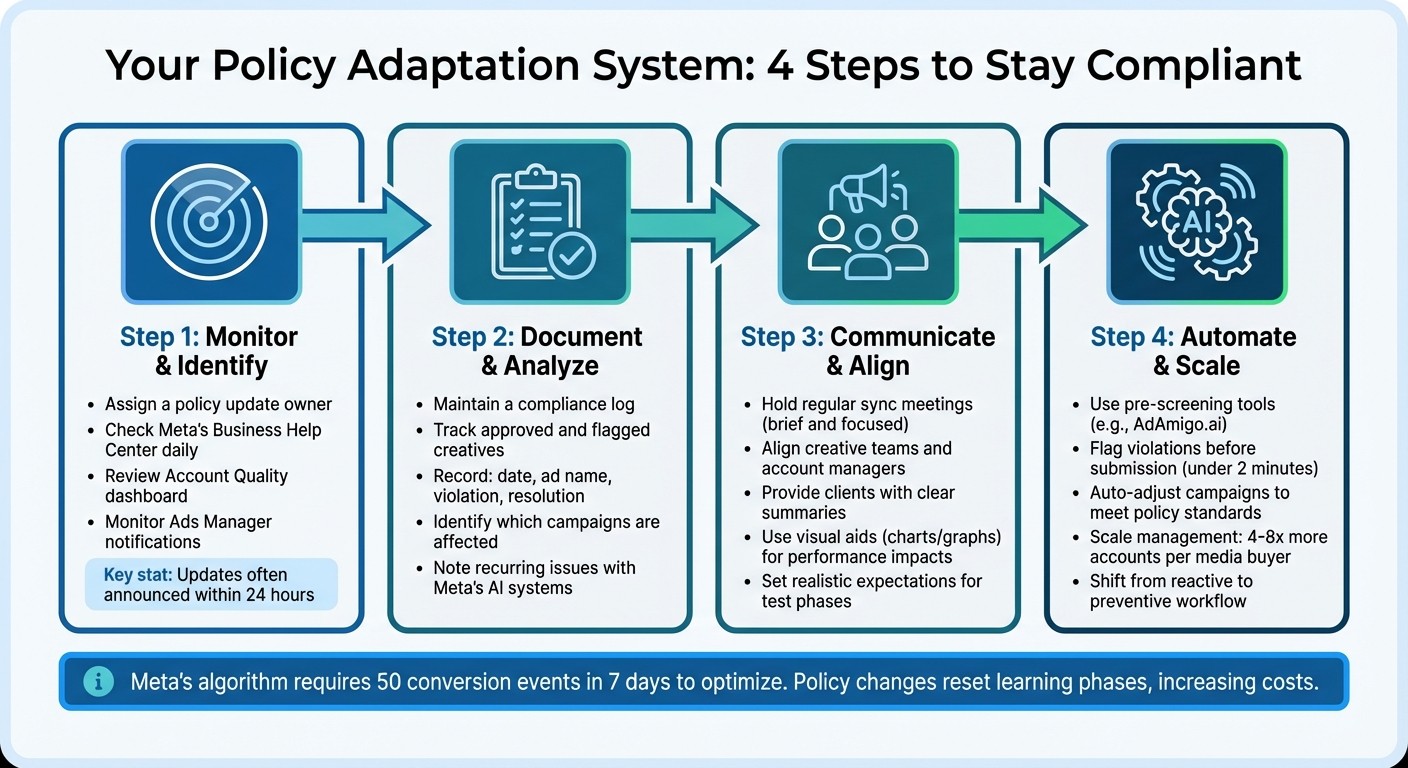
4-Step System for Managing Meta Ad Policy Changes and Maintaining Compliance
Why Meta Policy Updates Disrupt Ad Campaigns

Meta's policy updates can throw ad campaigns into chaos by altering rules while ads are already running. The platform's automated systems are constantly re-evaluating live ads. When policies change, ads that were previously approved might suddenly violate the new rules. This can lead to immediate rejections or even account-level restrictions, causing a ripple effect of increased disapprovals and restrictions.
As outlined in Meta's Advertising Standards:
Lower quality ads which do not necessarily violate our policies may experience impacted performance.
This decline in ad delivery often results in higher costs for advertisers.
Policy updates also shake up how advertisers collect and use data. For instance, when Meta reclassified health and wellness as a sensitive category in 2025, advertisers in that industry lost access to key tools like tracking pixels and the Conversions API for sensitive purchase data. This forced them to rebuild their conversion tracking systems from the ground up.
Areas Most Affected by Policy Changes
One of the hardest-hit areas is tracking and data collection. Policy changes can render established tracking methods useless overnight, creating significant technical challenges. Creative limitations also pose a problem. Even minor edits to ad content can trigger a full re-review process, which can stall campaigns and disrupt their momentum. These challenges highlight the importance of staying ahead of policy changes with agile compliance strategies.
How Meta Announces Policy Updates
Managing campaigns becomes even trickier because Meta doesn’t give advertisers much of a heads-up about policy changes. Instead, most advertisers only find out when their ads are rejected during the review process - often within 24 hours of the update. This lack of proactive communication makes it difficult to prepare and adapt quickly.
Common Problems and How to Fix Them
Ad Disapprovals and Account Restrictions
One common issue advertisers face is having their ads flagged for violating Meta's policies on personal attributes. Ads that mention personal characteristics - like race, religion, age, sexual orientation, or medical conditions - are automatically rejected. For example, phrases such as "Do you suffer from...?" will trigger disapproval instantly.
If you're advertising in sensitive areas like housing, employment, credit, health, or politics, you must classify your campaigns under Meta's special ad categories. These categories come with strict targeting limitations. Failing to self-identify or using prohibited targeting methods can escalate the issue, resulting in account-level restrictions instead of just ad rejections.
Landing pages are another critical factor. Make sure your landing page aligns with the promises in your ad. Pages should load within 3 seconds, include a visible privacy policy, and avoid pop-ups or redirects. Even if your ad complies with Meta's rules, a slow or misleading landing page can still lead to disapproval.
To address disapprovals, use Meta's Account Quality dashboard to identify the issue. Adjust any problematic language or creative elements, particularly those that focus on sensitive conditions. Experts recommend keeping a compliance log to track violations and document corrections for future reference.
Policy changes can also disrupt campaign performance, so staying informed is essential.
Performance Drops After Policy Updates
Policy updates can indirectly impact performance by resetting key learning phases. Meta’s algorithm relies on achieving 50 conversion events within a 7-day period to optimize delivery. When a policy change forces you to adjust targeting or ad creatives, it often resets the learning phase, leading to increased costs and reduced performance.
To minimize these disruptions, consider consolidating similar audiences. This approach helps you hit the 50-event threshold more quickly, stabilizing your campaigns. Also, avoid making frequent or significant edits to your ad sets, as this can further delay the learning process.
For campaigns in sensitive categories, shift your focus toward awareness and engagement metrics. Additionally, build first-party email and SMS lists to nurture leads outside of Meta's platform. This strategy allows you to maintain connections with your audience while navigating policy-related challenges.
How to Communicate Policy Changes Internally and with Clients
When Meta updates its policies, poor communication can lead to duplicated efforts, strained client relationships, and stalled campaigns. Because these updates often disrupt workflows, it’s essential to align internal processes and client communication to maintain trust and avoid unnecessary setbacks. Establishing clear communication protocols ensures you’re seen as a proactive partner who manages risks before they escalate into costly problems.
The goal is to treat policy updates as a shared responsibility, not just something for media buyers to handle. Everyone - creative teams, account managers, and other stakeholders - needs to understand how these changes affect their roles. Clients should also see that you’re actively addressing risks. Internally, assign clear responsibilities and use AI compliance tools to stay on top of updates.
Internal Team Communication Process
Start by designating one person as the policy update owner. This person will be responsible for monitoring Meta’s Business Help Center, checking the Account Quality dashboard daily, and reviewing notifications in Ads Manager. Having one point of accountability ensures updates are identified and handled promptly.
Integrate this process with your compliance log to maintain consistency. Create a compliance tracker to log approved and flagged creatives, including details like the date, ad name, violation, and resolution. This helps identify recurring issues with Meta’s AI systems and ensures your team can adapt quickly.
Regular sync meetings are crucial. Keep these brief and focused on what has changed, which campaigns are affected, and who is responsible for making adjustments. These meetings help keep the creative workflow aligned with the latest requirements.
How to Explain Policy Changes to Clients
When communicating with clients, provide a straightforward summary of the policy changes. Explain what has changed, why it matters to their campaigns, and what steps you’re taking to address the situation. Clear internal processes make it easier to present these updates transparently.
Use visuals to make the information digestible. Instead of overwhelming clients with raw data, share charts or graphs that show how policy updates correlate with performance shifts. This approach makes the impact clearer and easier to understand.
Before launching campaigns under new policies, conduct pre-mortem analyses. Identify potential risks, such as tracking issues or weak offers, and address them upfront. For example, when Meta rolled out new Lead Ads transparency rules in October 2025, agencies that proactively guided clients through the updated consent requirements avoided compliance problems that could have derailed campaigns. Frame these updates as opportunities to enhance user trust rather than just procedural hurdles.
Finally, set realistic expectations. After major policy changes, treat campaigns as test runs rather than aiming for immediate scaling. If you’re working in a newly restricted category, explain to clients that the initial focus will be on refining compliant messaging and achieving stable performance before pursuing aggressive growth.
Using Automation to Maintain Compliance and Scale
As policy changes continue to disrupt advertising campaigns, automation has become a critical tool for staying compliant and improving performance. Manual compliance checks often slow things down and increase the likelihood of human error. For instance, when Meta updates its policies, teams rushing to review every ad creative, landing page, and targeting parameter can easily overlook crucial details. Automation tools address this by scanning campaigns before they go live, catching potential issues early and ensuring campaigns remain compliant without delays.
Automation offers both speed and precision. While Meta’s review process can take up to 24 hours, automation tools identify issues ahead of time. This is crucial because even one policy violation can lead to an "Account Quality" strike, which may restrict your ability to run ads. Tools like AdAmigo.ai streamline this process by reviewing creatives, copy, and targeting against Meta’s guidelines in under two minutes. They automatically flag prohibited content, such as “before-and-after” images or unverified health claims, helping advertisers avoid costly setbacks.
How AdAmigo.ai Helps Advertisers
AdAmigo.ai complements internal processes by automating compliance updates across campaigns. Its AI Ads Agent generates ad creatives and copy that meet Meta’s guidelines, automatically filtering out restricted keywords like “cure,” “guaranteed,” or “instant relief.” When Meta introduced mandatory AI labeling in 2025, AdAmigo.ai adapted instantly, tagging synthetic content without any manual input. This removes the uncertainty around compliance and ensures advertisers stay ahead of policy changes.
The platform’s AI Actions feature provides a daily feed of prioritized recommendations to keep campaigns aligned with the latest rules. For example, if Meta tightens its restrictions on audience targeting for housing or employment ads, AI Actions flags discriminatory parameters and suggests compliant alternatives. Advertisers can either approve these changes manually or let the system implement them automatically.
For real-time support, the AI Chat Agent offers guidance on specific policy rules and handles large-scale updates. Need to adjust hundreds of ads to comply with new transparency standards? The chat agent can process those changes in minutes. Similarly, the Bulk Ad Launch feature ensures every ad in a large deployment passes rigorous compliance checks, whether you’re launching 10 ads or 500.
For industries with stricter regulations, like healthcare, AdAmigo.ai helps navigate Meta’s 2025 tiered restriction system. If conversion goals are removed due to policy updates, the platform suggests shifting to alternative objectives, such as Awareness or Engagement, ensuring campaigns remain active and effective even under tighter restrictions.
Benefits of AI-Driven Campaign Management
Automation doesn’t just keep campaigns compliant - it also improves overall efficiency. AI tools adapt to policy updates automatically, eliminating the need for manual adjustments. For agencies managing multiple clients, this is a game-changer. A single media buyer can handle 4–8 times more accounts by focusing on strategy while automation takes care of execution.
The benefits go beyond compliance. AdAmigo.ai optimizes every aspect of a campaign - creatives, targeting, bids, and budgets - within a unified system. It identifies top-performing elements and scales them faster than manual processes ever could. This allows agencies to manage more accounts while delivering better results through smarter, automated workflows.
Conclusion: Creating a Policy Adaptation System
Meta's advertising policies are constantly changing, and falling behind can cost both time and money. The most effective advertisers understand that compliance isn't a one-and-done task - it’s an ongoing process. By creating a system that keeps up with policy updates, communicates changes clearly, and uses automation, you can tackle issues before they turn into bigger problems. Staying ahead requires a proactive and organized approach.
Start by assigning someone on your team to check Meta's Business Help Center and notifications daily. When updates are released, document them, identify which campaigns are affected, and take immediate action using a compliance checklist. Share these updates with your team using a consistent format so everyone - whether they’re on the creative team or managing accounts - can easily grasp what’s changed. For clients, simplify the technical jargon into clear, actionable steps. For instance, if Meta introduces a new rule requiring AI labeling on synthetic images, explain how this impacts ad creatives and what adjustments are needed to stay compliant. This approach builds on earlier strategies for effective communication with both teams and clients.
To make the process even smoother, incorporate automation tools. Platforms like AdAmigo.ai can review ad creatives and targeting settings against Meta's guidelines, flagging potential problems before you submit ads for review. This shifts your workflow from reacting to issues to preventing them altogether.
The goal is to create a system that adapts and improves over time. Track what works, refine your communication templates, and let automation handle repetitive tasks, especially as Meta continues to enhance its enforcement mechanisms, like the Andromeda engine. With Meta moving toward more sophisticated compliance measures, having a structured process is key for advertisers aiming to scale without constant disruptions.
Take a moment to evaluate your current policy monitoring setup. If you’re relying only on manual checks or waiting until ads are disapproved to act, you’re leaving yourself vulnerable. Implement automated pre-screening, schedule regular reviews, and use AI tools for routine audits while your team focuses on strategy. The quicker you adapt, the less impact policy changes will have on your performance. By building this system, you can turn policy updates from obstacles into opportunities to refine and strengthen your advertising strategies.
FAQs
How can advertisers effectively handle Meta's frequent ad policy updates?
To keep up with Meta's frequent ad policy updates, think of compliance as an ongoing process rather than a one-and-done effort. Start by staying in the loop - subscribe to Meta’s Business Help resources and regularly review their Advertising Standards. This will keep you updated on the latest rules for ad content, targeting, and landing pages.
Build a routine checklist to audit your ads and ensure they align with Meta’s guidelines. This means double-checking for prohibited language, making sure targeting follows special category restrictions, and verifying that landing pages match the promises made in your ad content.
For a more streamlined approach, you might want to explore AdAmigo.ai, an AI-driven platform designed to monitor your campaigns for compliance. It flags issues like banned phrases or improper targeting and offers actionable fixes. By combining real-time updates, regular audits, and AI automation, you can reduce ad rejections, protect your account, and keep your campaigns running smoothly.
How can I avoid getting my Meta ads disapproved?
To steer clear of Meta ad disapprovals, start by making sure your ad creatives and copy align with Meta's advertising policies. Avoid using restricted phrases like “guaranteed results” or visuals such as before-and-after images. Double-check that your landing page matches the ad’s message, includes any required legal disclosures, and is free of broken links. Also, ensure your targeting settings meet the requirements for special-ad categories (like housing or employment) and adhere to any age or location restrictions.
For a smoother process, tools like AdAmigo.ai can be game-changers. Its AI Ads Agent reviews your creatives for potential compliance issues and offers suggestions to fix them before launch. Meanwhile, its AI Actions feature provides daily updates to help you stay on top of policy changes and keep your campaigns compliant. These tools adjust to Meta’s constantly evolving rules, saving you time and reducing the chance of rejections.
By combining thorough manual checks with AI-driven tools, you can cut down on ad disapprovals and keep your campaigns running without interruptions.
How can automation help ensure compliance with Meta's ad policies?
Automation makes it easier to stay on top of Meta's ad policies by keeping a constant eye on campaign elements like ad copy, images, targeting, and landing pages. With AI-powered tools, issues like banned language, incorrect targeting, or restricted content can be flagged or fixed in no time, helping you avoid ad rejections or even account suspensions.
These tools also offer daily, prioritized suggestions for compliance updates - things like tweaking audience settings or updating privacy disclosures - so you can respond quickly without combing through every campaign yourself. By integrating these checks into your workflow, automation ensures your ads stay in line with Meta’s rules, giving you more time to focus on strategy and scaling your business.